
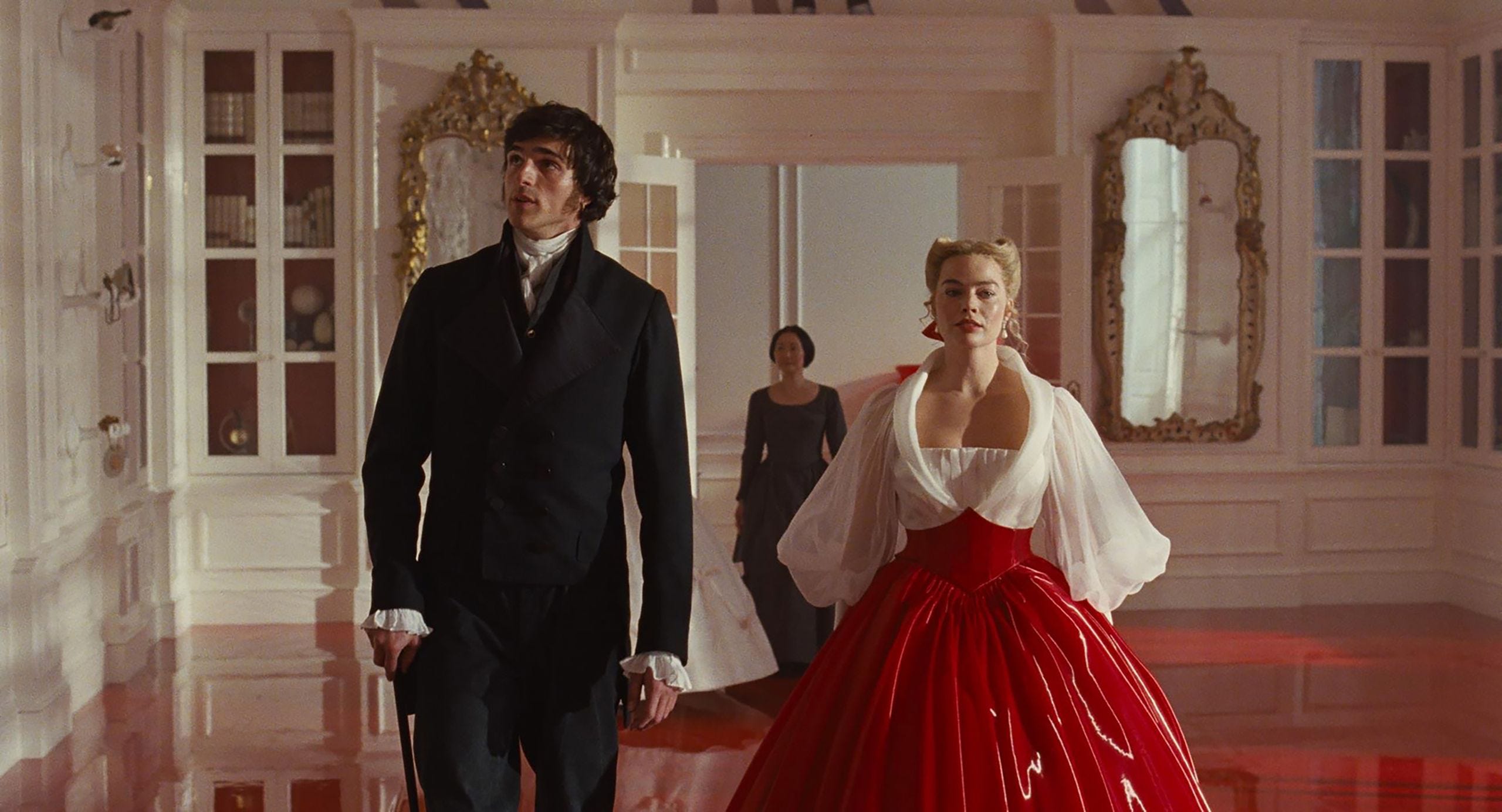
The discourse around Emerald Fennell’s “Wuthering Heights” has been rampant, and prior to the critics’ reviews, was dominated by accusations of whitewashing in response to the casting of Jacob Elordi as Heathcliff. Social media exploded with text-truthers insisting that a person of color should have been cast instead. But this response, while textually informed, is critically shallow, bordering on covertly racist.
The director of “Wuthering Heights” has been vocal about her choices. She isn’t claiming allegiance to the verbatim text, and she acknowledges that film renders novels to a two-dimensional format. The trailer even describes it as “inspired by the greatest love story” rather than “based on.” In her Fandango interview, she explained the quotation marks around the title:
“The thing for me is you can’t adapt a book as dense and complicated and difficult as this book. I can’t say I’m making Wuthering Heights. It’s not possible. What I can say is I’m making a version of it.
There’s a version that I remembered reading that isn’t quite real. And there’s a version where I wanted stuff to happen that never happened. And so it is ‘Wuthering Heights’, and it isn’t.”
The “whitewashing” critique comes primarily from white English majors who haven’t grappled with what representation as a gothic villain actually means, particularly in the film medium. The text of Wuthering Heights is rife with racist commentary about Heathcliff, yet it offers remarkably vague physical descriptions and background clues.
He is said to be “dark,” “black-haired,” and “gipsy in aspect,” found starving in Liverpool, possibly arriving from the Lascar colonies (suggesting South Asian descent) or possibly even of Romani heritage. But this is deliberately ambiguous and open for interpretation. Brontë gives no actual cultural context: no language, no traditions, no community. “Gipsy” functions purely as a slur and shorthand for dubiousness and permanent outsider status. In stark contrast to these infrequent physical descriptions, the novel is saturated with racialized language and dehumanization. He is repeatedly called “it,” “dog,” or “dirty,” and constantly likened to brutes, savages, animals or beasts.
 Tiktok failed to load.
Enable 3rd party cookies or use another browser
On screen, any specific racial identity risks reproducing harmful stereotypes about violent, criminal brown men – stereotypes that have endured since the Victorian times to today. Without any cultural grounding, this “representation” would more likely read as tokenization. And I’ll save you the rant about the sexualization of Black people in media dating back centuries, as that conversation is taking place surrounding Teyana Taylor’s character in One Battle After Another. By removing the racial question entirely, Fennell can focus on what the novel actually explores: class, ambition and the violence of social hierarchy (and codependency, the lasting effects of childhood trauma, etc., etc.).
Fennell knows the text. She knows the racial coding. She’s worked with the Brontë Parsonage Museum to produce this film. The title’s quotation marks suggest she’s made conscious choices to deviate, in my opinion, correctly navigating the challenge of adapting this “complex” text in 2026.
And sure, Fennell’s adaptation was somewhat kind to Heathcliff, but his real deviousness amps up in the second half of the novel, which almost no filmmaker has dared to touch. Thus, had she cast a man of color and centered his racial identity as the text suggests, at best, you would even further humanize a character Brontë wrote as fundamentally irredeemable, and at worst, you would suggest his race is intrinsic to his irredeemability.
Sometimes the ~progressive~ thing to do is recognizing that a text is too embedded in racist stereotypes to adapt “faithfully.” Sometimes representation means saying, “Actually, we don’t need another story about a violent, criminal, irredeemable brown man, even if the source material suggests he is not white.” And this is not a takedown of my girl Emily Brontë!!!! The woman had connections to the abolitionist movement. Creating a possibly Black/South Asian/Romani protagonist who successfully climbs the social ladder, owns property, and successfully exacts revenge was edgy, even potentially revolutionary for 1847.
But what does it mean to regurgitate that narrative in 2026? We know more now about how stereotypes function. We understand the harm of representing non-white people primarily as violent, scheming villains: the hypersexual threat to white women, the vengeful outsider sabotaging civilized society, the irredeemable criminal climbing the social ladder only to destroy it. So, resist the urge to jump straight to “Why didn’t they cast a POC?” and stop to consider “What kinds of stories do we want to tell about this marginalized group of people, and is this one of them?” I know it’s hard to fathom at times, but this world has made some progress over the last 150 years. Time gives us perspective, even, or maybe especially, on our most beloved texts.